Frequency as a synthetic spin
Three-wave mixing provides more than wavelength conversion: the complex amplitudes of signal and idler waves form a two-component state mathematically equivalent to a spin-1/2 particle. The nonlinear coupling magnitude and phase, together with phase mismatch, act as an effective magnetic field on this spectral pseudospin, while propagation through the crystal plays the role of time. Engineered nonlinear photonic crystals therefore provide a flexible laboratory for translating quantum-mechanical spin dynamics into controllable optical propagation.
Our 2018 All-Optical Stern–Gerlach Effect work established how a transverse gradient in nonlinear coupling splits an input beam into spatial directions associated with orthogonal signal–idler superpositions. A companion Optica study extended the idea into the frequency domain for photonic qubits and qutrits. In 2022, the all-optical Stern–Gerlach effect was observed experimentally: a nonlinear coupling gradient split light into two beams carrying frequency-bin superpositions, while phase-sensitive preparation directed selected superpositions into a single output.
Geometric phase through nonlinear conversion
A second line of work uses adiabatic frequency conversion to produce Berry-type geometric phases. In the 2018 theory, signal and idler amplitudes trace trajectories on a Bloch sphere as the effective nonlinear coupling changes along the crystal. The accumulated phase depends on the geometry of that path and can therefore be controlled through the nonlinear modulation pattern, enabling wavefront shaping, focusing, and mode conversion.
The 2019 Optica experiment directly observed this adiabatic geometric phase in nonlinear frequency conversion. Tailored nonlinear photonic crystals demonstrated geometric-phase beam shaping, enlarged conversion bandwidth, opposite phases for orthogonal eigenstates, asymmetric propagation, and pump-biased nonreciprocity. The 2020 fully nonlinear treatment then removed the undepleted-pump approximation: all three interacting waves could exchange substantial energy, yet a geometric phase remained well defined on the resulting nonlinear state surface. Its magnitude and sign could be controlled through modulation period, phase, and duty cycle.
Our review of geometric phase in nonlinear frequency conversion connects these bulk-crystal results to nonlinear Pancharatnam–Berry metasurfaces, holography, imaging, and quantum-light applications.
Skyrmions and Hall-like transport
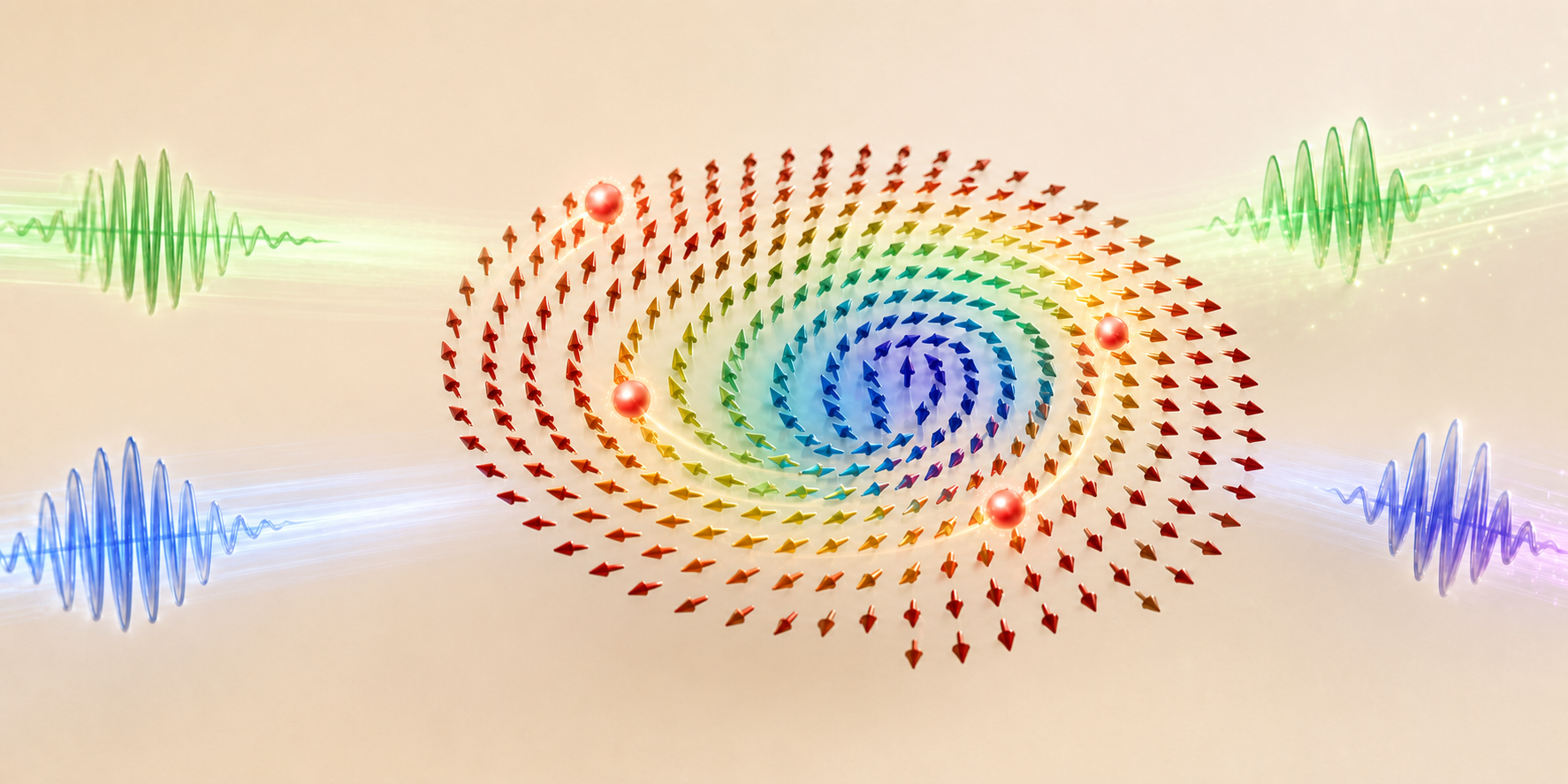
The same spectral pseudospin can emulate transport through spatially varying magnetic textures. In the 2021 Nature Communications work, a three-dimensional nonlinear photonic crystal was designed so that its local coupling defines an effective two-dimensional magnetization landscape. As light propagates and its pseudospin adiabatically follows this texture, it accumulates a position-dependent geometric phase. The associated synthetic gauge field produces transverse beam deflection analogous to the topological Hall effect.
We designed skyrmionic coupling textures—including high-order configurations difficult to stabilize in magnetic materials—and demonstrated controllable Hall-like deflection and reversal with propagation direction or pseudospin. The platform makes spin, magnetization, and gauge-field dynamics programmable through optical frequencies, nonlinear coupling, and geometric phase.
Optical spintronic devices
These analogies also motivate device concepts. The 2024 Optics Letters work introduced an all-optical spin valve and spin-dependent beam splitter in a two-dimensional nonlinear photonic crystal. The signal–idler superposition acts as the pseudospin, while the pump controls the effective magnetization. Changing the pump tunes transmission angle and splitting ratio, creating a reconfigurable frequency-domain analogue of spin-dependent transport for classical and quantum optical information processing.
Disorder, localization, and spin-glass physics
The 2025 Physical Review Letters work moved from ordered textures to disordered vectorial coupling. Random transverse variations of the second-order nonlinear interaction create an optical analogue of a disordered spin-glass magnetic phase. The study predicted and experimentally demonstrated transverse localization of the signal–idler pseudospin current.
Unlike conventional Anderson localization driven by a scalar refractive-index potential, this localization arises from a disordered vectorial pseudospin potential and depends strongly on pump-controlled nonlinear coupling. Decaying Rabi oscillations between frequency components further indicate longitudinal decoherence connected to the disorder.
This controllable optical platform opens a direct route to exploring transport, localization, and decoherence across complex magnetic-like landscapes.