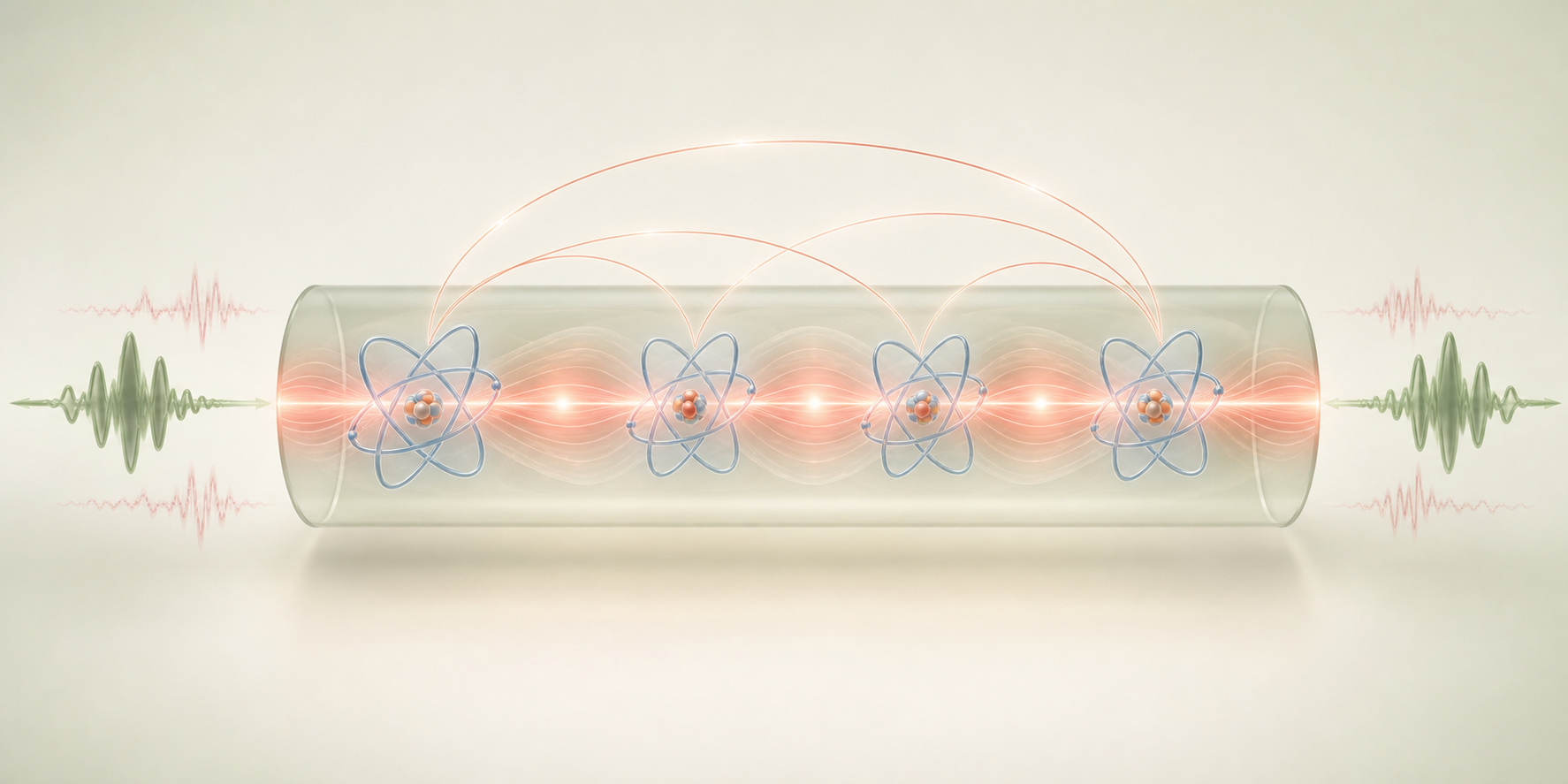
Engineering interactions with nonlinear waveguides
When several quantum emitters couple to the same waveguide, photons carry information and interactions between them. The resulting collective dynamics can produce bright states, which radiate efficiently, and dark states, in which destructive interference suppresses emission. Dark states are attractive because their isolation from the waveguide can protect quantum information. The same isolation, however, makes them difficult to prepare, manipulate, and measure.
Our work explores how optical nonlinearity changes this balance. We consider one-dimensional arrays of emitters coupled to a waveguide that acts as a traveling-wave parametric amplifier. A coherent pump drives the nonlinear medium and generates squeezed propagating fields. These fields alter both the effective interactions and the collective dissipation experienced by the emitters, creating a controllable setting in which the photonic environment can protect selected states while mediating interactions across the array.
Decoherence-free many-body Hamiltonians
In Decoherence-free many-body Hamiltonians in nonlinear waveguide quantum electrodynamics, we show theoretically that parametric gain produces emitter–emitter interactions that persist where conventional coherent waveguide-mediated interactions vanish. For emitters separated by integer multiples of the resonant wavelength, ordinary exchange interactions are washed out even though the array supports a decoherence-free subspace. The nonlinear waveguide changes this structure: photons are amplified as they propagate, and the resulting effective coupling can increase with emitter separation.
The induced Hamiltonian creates and annihilates pairs of emitter excitations rather than simply exchanging one excitation between sites. In the weak-gain limit, rapidly decaying bright components are suppressed by quantum-Zeno dynamics, while slower evolution remains predominantly inside the dark-state manifold. The effective dynamics therefore approaches coherent, nearly unitary evolution within a decoherence-free subspace, despite the system remaining coupled to an open waveguide.
This mechanism offers a route for preparing many-body entangled dark states from the collective ground state using global squeezing drives, without independently addressing every emitter.
Making dark states visible
Protection alone does not solve the problem of readout. A perfectly dark state has no ordinary radiative signature: if it is completely decoupled from the guided field, standard transmission or fluorescence spectroscopy cannot detect it directly. In Dark state spectroscopy in nonlinear waveguide quantum electrodynamics, we propose a method for probing these otherwise hidden collective states without relying on imperfections that deliberately shorten their lifetimes.
Weak squeezed light generated inside the nonlinear waveguide dresses the dark-state manifold and breaks the permutation symmetry that keeps the states inaccessible in a linear system. The squeezed vacuum drives transitions between dressed dark eigenstates, allowing their energy differences to appear in the steady-state incoherent fluorescence spectrum. A parity selection rule determines which transitions contribute.
For a four-emitter model, the predicted spectrum contains three characteristic peaks associated with allowed dark-state transitions. Larger arrays have a higher-dimensional dark manifold and a richer spectrum. Pump strength introduces a practical trade-off: stronger squeezing separates the transition frequencies but also broadens their spectral features.